


Apocynaceae
Dischidia platyphylla
VAT included · plus
- Curated selection:
Every plant is hand‑picked for health and visual appeal, so you receive a strong, well‑established plant.
- Representative photos:
Product images show a typical plant of this variety. Natural differences in leaf number, shape or variegation are normal – your plant will still match in type and quality.
- Size details:
Listed sizes refer to pot diameter (cm) and approximate overall height (cm) from the base of the pot to the tallest leaf or stem.
- “Get What You See” items:
If you are buying the exact plant shown in the photos, this is clearly stated in the size section.
- Individual photos:
One‑off photos are only provided when this is explicitly mentioned in the size section. - For special traits or small quirks, please check the full product description.
Secure shipping – carefully packed orders with safe delivery across the EU, UK and Switzerland.
28-day plant guarantee – if a plant arrives damaged or fails soon after delivery, we help you make it right.
Free returns – simple, cost-free returns according to our policy.
For full details, please see:
Please head to our FAQ Page or Contact us.
Interested in Dischidia platyphylla? Worth reading:
The Ultimate Guide to Watering Houseplants: Everything You Need to Know to Keep Your Indoor Garden Thriving

So how Much Light is 'Plenty of Bright, Indirect Light'
Dischidia platyphylla at a glance:
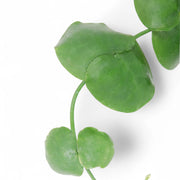
Dischidia platyphylla arranges flat paddle-like leaves in opposite pairs along slender stems, often holding them nearly flush against a support so the plant reads more like a pattern than a typical vine. It grows slowly but steadily, usually reaching about 50–100 cm depending on whether it is mounted, potted, or allowed to trail.
Bright filtered light, strong airflow, and an open epiphytic mix with bark and perlite are more important than frequent watering, because this species stores some moisture in its thick leaves and resents staying wet. Let the substrate dry most of the way before watering again, keep temperatures in the warm 20–26 °C range, and aim for humidity around 60–80% if possible. Mounted culture suits it well, and simple node cuttings root easily in moist moss.


Dischidia platyphylla
Quick Care Guide
Light
Bright indirect • approx. 10,000–20,000 lux
Water
Water when ~70–90% dry
Substrate
Airy + fast-draining • Light moisture buffer • Bark-based • Medium-chunky
Temperature
Ideal: 18–28 °C • Avoid below: 15 °C
Humidity
Humid 60–80 % +
Growth habit
climbing subshrub
Support
optional
Growth speed
Average
Max size indoors
Max. trail length: 100 cm • Max. spread: 50 cm
Toxicity & safety
Mildly toxic
Origin & habitat
Philippines; wet tropical habitat
How to read these metrics
These metrics are standardised reference points. We compile them by reviewing and cross-checking multiple botanical and horticultural references, then refining them through real-world growing experience. Source links: Plant Care Resources.
Please use the values as guidance. Conditions vary by home, so the same plant can respond differently. For plant-specific context, read the full product description and browse our Plant Care Guides.
- Light: level + approximate lux at leaf level;
- Watering: “% dry” is the trigger before watering again; lower % stays more evenly moist.
- Potting mix: one-line profile (structure/drainage • moisture buffer • base • particle size).
- Temperature: “Ideal” comfort range; “Avoid below” marks higher stress risk.
- Humidity: target bands (Normal/Moist/Humid); consistency usually matters most.
- Growth habit: growth form (rosette, trailing, climbing) for placement and training.
- Support: needed/optional/none — whether stake, pole, or trellis improves structure and size.
- Growth speed: fast/average/slow under decent indoor conditions—expectations, not a promise.
- Max size indoors: realistic long-term potential; format differs for climbers vs. trailers.
- Toxicity & safety: chemical irritants/toxicity and physical hazards (spines, bristles).
- Origin & habitat: native region + typical biome/habitat as context.
Plant Care Basics:
- Care basics – Main hub with links to all houseplant care guides.
- After delivery & first week – Unpacking, first placement, and early recovery.
- Light – How much light houseplants really need indoors.
- Watering – When to water and how to avoid root rot.
- Substrates & roots – Potting mixes and drainage for strong root systems.
- Humidity – When humidity matters and what actually helps.
- Fertilizing – Simple feeding routine without burning roots.
- Problems & pests – Yellow leaves, brown tips, bugs, and fixes that work.
- Semi-hydro – How to run low-maintenance mineral substrates.
Your new plant has just travelled a long way and needs a calm start in its new home. For step-by-step unboxing and first-week care, check our after-delivery care guide. For deeper tips on how your plant settles in over the next weeks, read our houseplant acclimatization guide.
Dischidia platyphylla
Sale price €40,00