

Euphorbiaceae
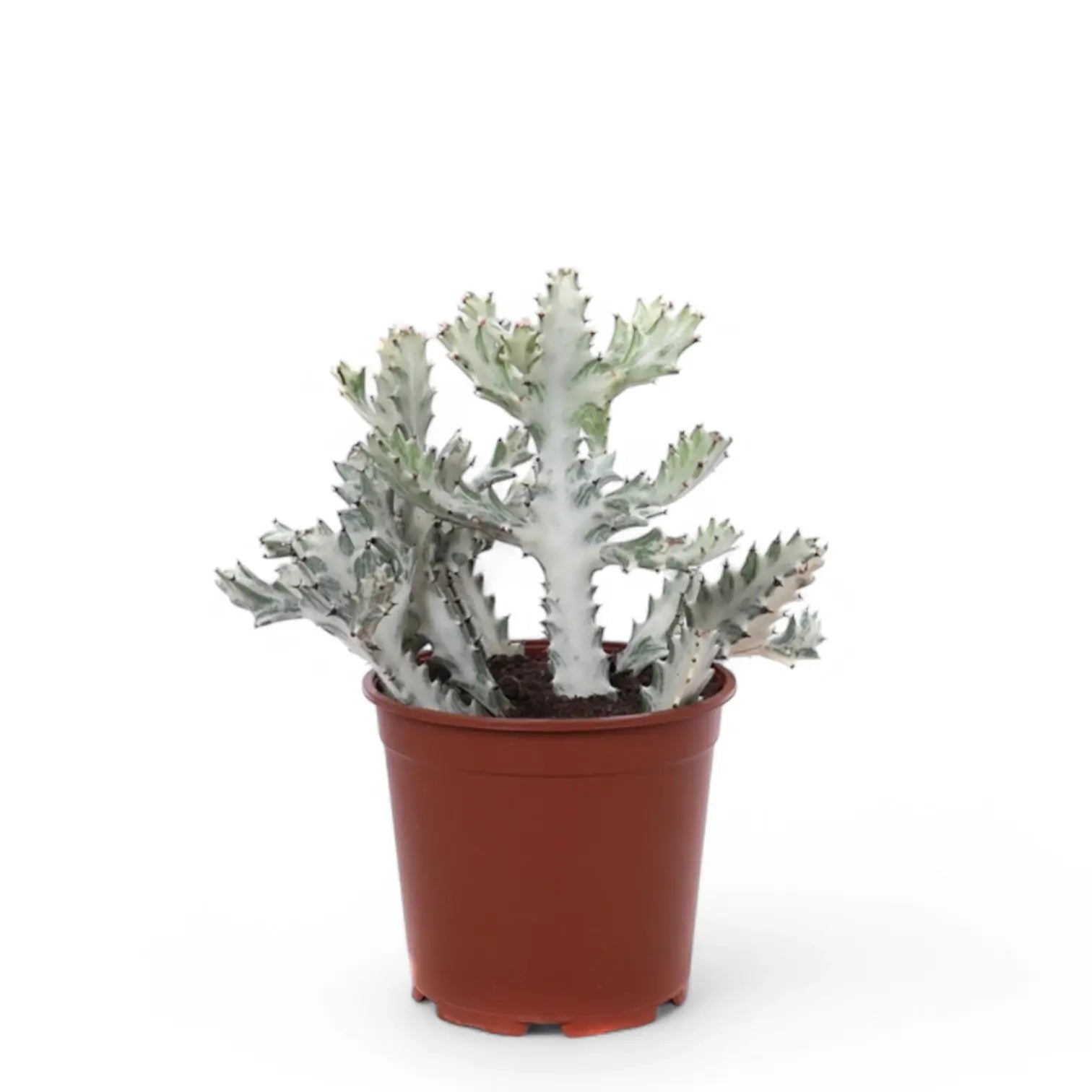
Euphorbia lactea 'White Ghost' ('Grey Ghost')
VAT included · plus
- Curated selection:
Every plant is hand‑picked for health and visual appeal, so you receive a strong, well‑established plant.
- Representative photos:
Product images show a typical plant of this variety. Natural differences in leaf number, shape or variegation are normal – your plant will still match in type and quality.
- Size details:
Listed sizes refer to pot diameter (cm) and approximate overall height (cm) from the base of the pot to the tallest leaf or stem.
- “Get What You See” items:
If you are buying the exact plant shown in the photos, this is clearly stated in the size section.
- Individual photos:
One‑off photos are only provided when this is explicitly mentioned in the size section. - For special traits or small quirks, please check the full product description.
Secure shipping – carefully packed orders with safe delivery across the EU, UK and Switzerland.
28-day plant guarantee – if a plant arrives damaged or fails soon after delivery, we help you make it right.
Free returns – simple, cost-free returns according to our policy.
For full details, please see:
Please head to our FAQ Page or Contact us.
Interested in Euphorbia lactea 'White Ghost' ('Grey Ghost')? Worth reading:

Arid vs. Jungle Succulents: Care, Traits & Key Differences

Nighttime Photosynthesis: How CAM Plants Thrive on Scarcity
Euphorbia lactea 'White Ghost' ('Grey Ghost') at a glance:
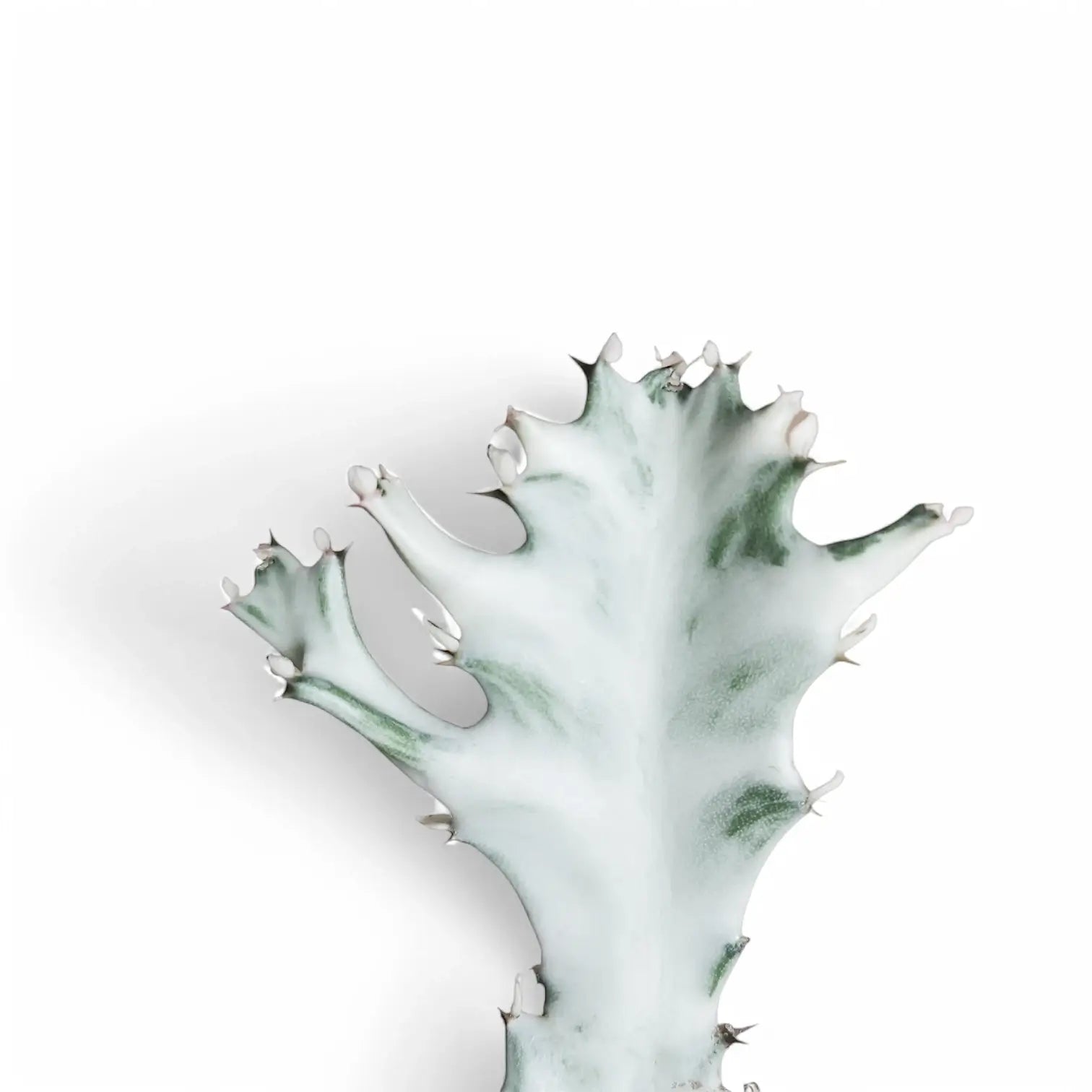
Euphorbia lactea 'White Ghost', also sold as 'Grey Ghost', carries almost chlorophyll-free triangular stems in cream, pale grey, and faint green marbling, creating a candelabra shape that looks more sculpted than alive. Indoors it remains slower and somewhat more light-sensitive than greener forms, but it is still surprisingly resilient on its own roots when given the right conditions: very bright filtered light, a sharply draining mineral substrate, long dry intervals, and warmth above about 15 °C. The pale stems can scorch under abrupt hard sun, so acclimation matters, yet weak light quickly leads to loss of form and poor growth.
Mature plants eventually become tall and architectural, making heavy pots and stable placement useful.
Like all Euphorbias, it produces caustic white latex that irritates skin and eyes and is poisonous if ingested, so handling should always be done carefully and with gloves where possible.

%20at%20a%20glance:Euphorbia%20lactea%20'White%20Ghost',%20also%20sold%20as%20'Grey%20Ghost',%20carries%20almost%20chlorophyll-free%20triangular%20stems%20in%20cream,%20pale%20grey,%20and%20faint%20...)
Euphorbia lactea 'White Ghost' ('Grey Ghost')
Quick Care Guide
Light
Full sun / direct • approx. 40,000–80,000 lux
Water
Water when ~90–100% dry
Substrate
Gritty • Ultra fast-draining • Mineral-heavy • Fine-medium
Temperature
Ideal: 18–30 °C • Avoid below: 10 °C
Humidity
Normal 40–50 %
Growth habit
crested succulent
Support
not needed
Growth speed
Slow
Max size indoors
Max. height: 300 cm • Max. spread: 150 cm
Toxicity & safety
Toxic
Origin & habitat
Cultivar of Euphorbia lactea
How to read these metrics
These metrics are standardised reference points. We compile them by reviewing and cross-checking multiple botanical and horticultural references, then refining them through real-world growing experience. Source links: Plant Care Resources.
Please use the values as guidance. Conditions vary by home, so the same plant can respond differently. For plant-specific context, read the full product description and browse our Plant Care Guides.
- Light: level + approximate lux at leaf level;
- Watering: “% dry” is the trigger before watering again; lower % stays more evenly moist.
- Potting mix: one-line profile (structure/drainage • moisture buffer • base • particle size).
- Temperature: “Ideal” comfort range; “Avoid below” marks higher stress risk.
- Humidity: target bands (Normal/Moist/Humid); consistency usually matters most.
- Growth habit: growth form (rosette, trailing, climbing) for placement and training.
- Support: needed/optional/none — whether stake, pole, or trellis improves structure and size.
- Growth speed: fast/average/slow under decent indoor conditions—expectations, not a promise.
- Max size indoors: realistic long-term potential; format differs for climbers vs. trailers.
- Toxicity & safety: chemical irritants/toxicity and physical hazards (spines, bristles).
- Origin & habitat: native region + typical biome/habitat as context.
Plant Care Basics:
- Care basics – Main hub with links to all houseplant care guides.
- After delivery & first week – Unpacking, first placement, and early recovery.
- Light – How much light houseplants really need indoors.
- Watering – When to water and how to avoid root rot.
- Substrates & roots – Potting mixes and drainage for strong root systems.
- Humidity – When humidity matters and what actually helps.
- Fertilizing – Simple feeding routine without burning roots.
- Problems & pests – Yellow leaves, brown tips, bugs, and fixes that work.
- Semi-hydro – How to run low-maintenance mineral substrates.
Your new plant has just travelled a long way and needs a calm start in its new home. For step-by-step unboxing and first-week care, check our after-delivery care guide. For deeper tips on how your plant settles in over the next weeks, read our houseplant acclimatization guide.