
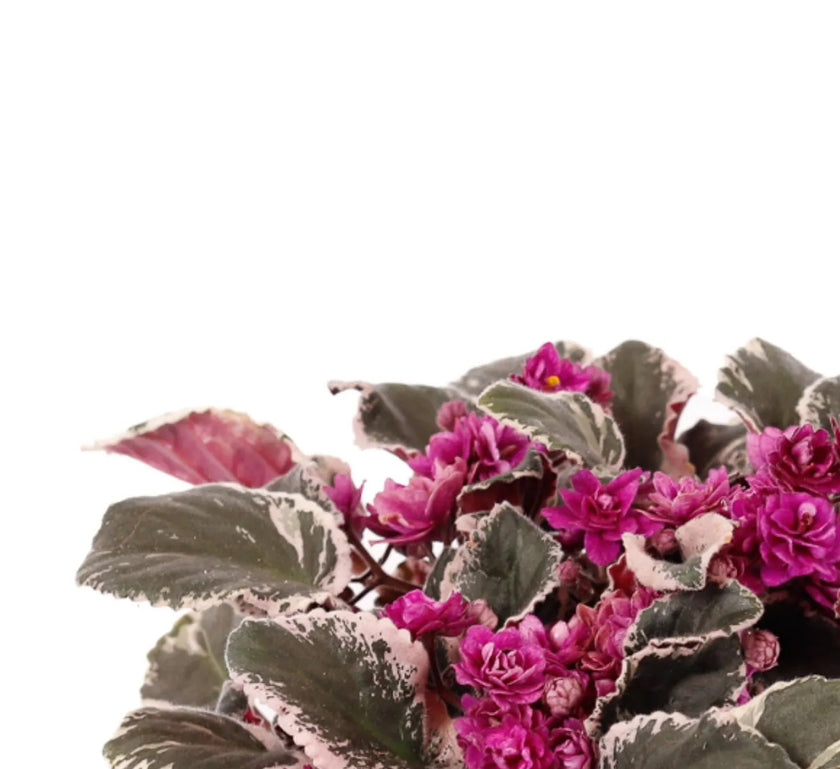


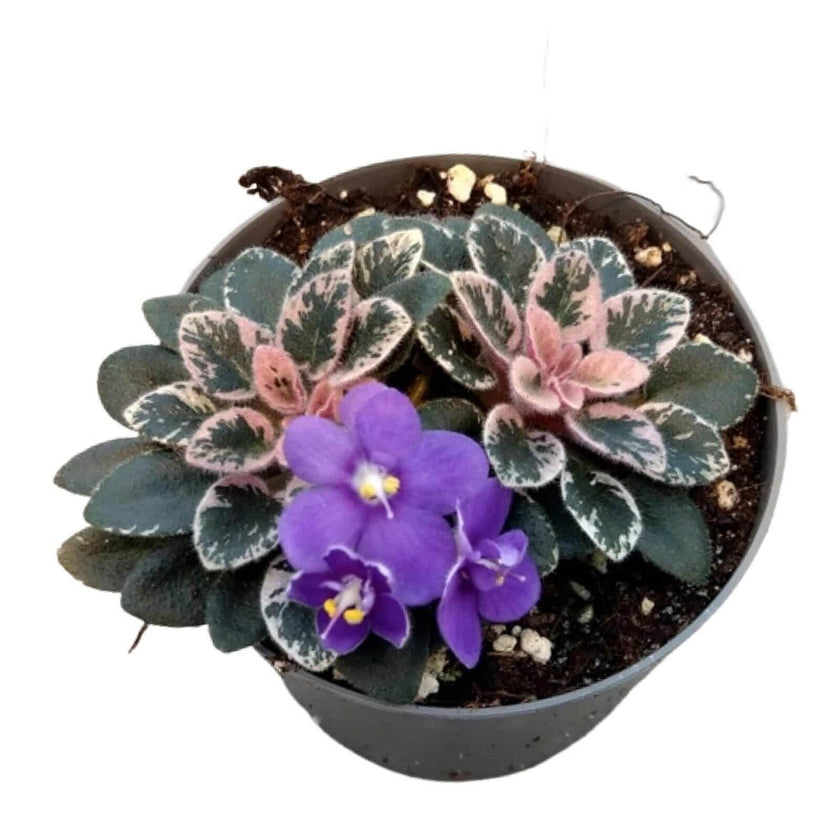
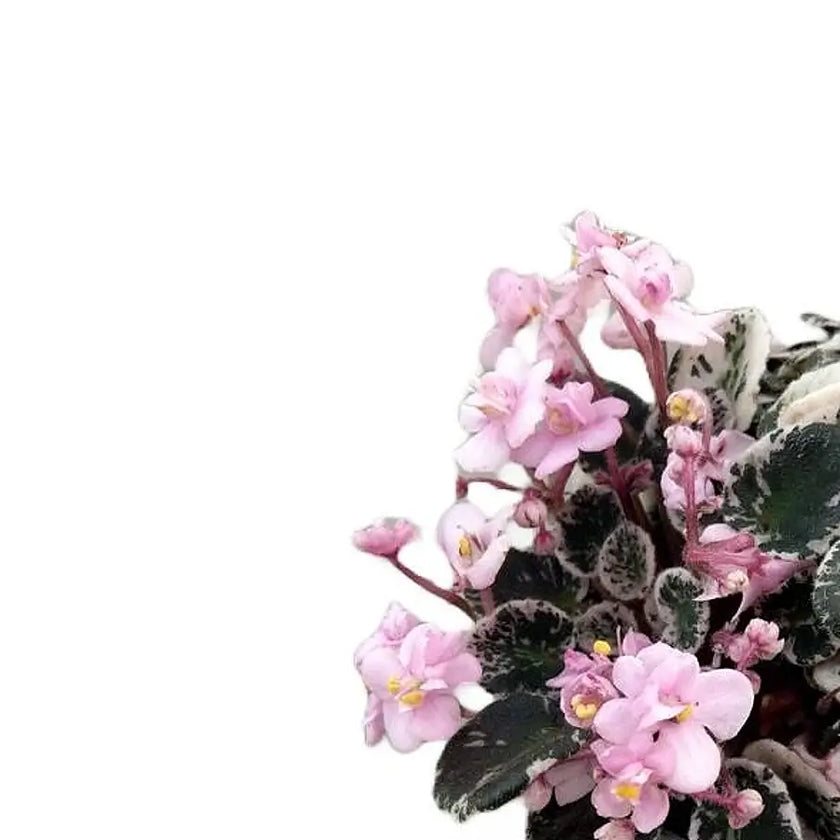


Streptocarpus (sect Saintpaulia): African Violets
African violets are compact rosette Gesneriads with velvety leaves and repeat flowers under soft, bright light. Indoors they are small but particular: light, open mixes, lukewarm water kept off the leaves and steady warmth make more difference than any “magic” tricks. Need bright, indirect light on sills or under lights; harsh sun and deep shade both cut bloom. Prefer very airy violet mixes, small pots and careful watering that avoids crown rot. Reward consistent conditions with long runs of colour in modest space. Choose African violets when you want ongoing flowers from plants that fit comfortably on shelves and window ledges.

About Our Filters
Filters help you narrow things down fast and without guessing. We put a lot of time and effort into keeping filter values consistent across the shop by cross-checking references and validating them against real-world indoor growing and handling.
Use them as guidance, not guarantees. Homes vary a lot, so for the full context (and any exceptions), open the product page and read the description.
How filtering works
- Filters stack: each selection narrows results.
- Multiple picks in one filter are usually either/or within that filter.
- Undo anytime: click a selected option again (or clear filters).
Safety
- Non-toxic: not known for relevant chemical toxicity for common pets (chewing can still cause irritation).
- Non-toxic & Pet Friendly: stricter shortlist that also avoids many physical hazards like spines, sharp tips, thorns, and bristles.
Common care filters
- Light level: Low indirect → Full sun/direct.
- Water Needs: Low / Medium / High.
- Humidity Level: Normal (40–50%) / Moist (50–60%) / Humid (60–80%+).
Growth & size
- Growth Habit: climbing, trailing, crawling, upright, self-heading, clumping, rosette.
- Needs support? none / optional / needed.
- Delivered size: pot size + plant height at shipping.
- Max size indoors: realistic long-term height + spread indoors.
Looks & botanical browsing
- Leaf Shape & Size + Foliage Colour: quick visual categories.
- Plant Type / Genus / Family: browse by broad group or taxonomy.
If you want to see the references we use, Plant Care Resources is simply a curated list of source links (POWO, Kew, and more).
Sort by
Filters
Gesneriaceae
Streptocarpus (sect Saintpaulia): African Violets
Quick Overview
African violets (Streptocarpus sect. Saintpaulia) - rosette care
- Habit: small rosettes with velvety leaves and repeat-blooming flower clusters; ideal for bright sills and shelves.
- Light: bright, indirect light; east or bright north windows are ideal, harsh sun and deep shade both reduce performance.
- Substrate: needs very light, airy violet mix; heavy compost around fine roots leads to rot.
- Watering: use lukewarm water when surface is just dry; avoid soaking the crown or splashing cold water on leaves.
- Temperature: enjoys mild, steady warmth; cold draughts and sudden chills often cause leaf and bud loss.
- Feeding: light, regular fertiliser in growth and bloom is better than strong, occasional doses.
Botanical Profile
Streptocarpus (sect Saintpaulia): African Violets: botanical profile for Tanzanian gesneriads
Streptocarpus sect. Saintpaulia is a section within Streptocarpus subgenus Streptocarpella (family Gesneriaceae), comprising about ten species of small, caulescent, rosette-forming herbs formerly treated as the separate genus Saintpaulia. These plants, including Streptocarpus ionanthus and its subspecies, are the true African Violets of cultivation, valued for compact habit and velvety, colourful flowers.
- Order: Lamiales
- Family: Gesneriaceae
- Tribe: Trichosporeae (subtribe Streptocarpinae)
- Genus: Streptocarpus Lindl., section Saintpaulia
- Type species: Streptocarpus ionanthus (H.Wendl.) Christenh. (≡ Saintpaulia ionantha H.Wendl.)
- Chromosomes: Subtribe Streptocarpinae shows base numbers x ≈ 15-16; section Saintpaulia has a characteristic diploid number 2n = 30.
Range & habitat: Native to the Eastern Arc Mountains and associated highlands of Tanzania and adjacent southeastern Kenya, African violets grow on shaded, moss-covered rock faces, cliff ledges and boulders under montane forest canopies, typically between about 300 and 1 500 m elevation where cloud immersion and high humidity are frequent.
- Life form: Small, perennial herbs with short, often branched stems and basal rosettes, forming loose cushions on rock or thin forest soils.
- Leaf attachment: Opposite or spiral leaves on relatively long, fleshy petioles, often forming overlapping rosettes that sit close to the substrate.
- Leaf size: Typically 2.5-8.5 cm long and 2-6 cm wide in wild plants; cultivated forms span from micro types under 3 cm rosette diameter to large forms over 15 cm across.
- Texture & colour: Thick, softly pubescent, slightly succulent blades, usually mid- to dark green above and paler beneath; hairs give a velvety appearance and influence water films on the surface.
- Notable adaptation: High shade tolerance and leaf morphology tuned to intercept diffuse cloud-forest light allow these plants to photosynthesise effectively at very low irradiance while avoiding damage from intermittent sunflecks.
Inflorescence & fruit: Slender, leafless peduncles arise from the rosette bearing cymes of 3-10 or more zygomorphic flowers with a five-lobed, velvety corolla in violet, purple, blue or white. Fruits are slender, twisted capsules that dehisce to release numerous dust-like seeds, dispersed by air currents across nearby rock faces.
Details & Care
Streptocarpus (African violets) - velvet rosettes for long-term colour
Streptocarpus (African violets) - rosettes, velvet leaves and year-round colour
Streptocarpus sect. Saintpaulia is the African violet group within the Gesneriaceae. Once treated as the separate genus Saintpaulia, molecular work has placed these plants inside Streptocarpus, but in cultivation they are still widely known simply as African violets. They are compact, evergreen rosette plants with softly hairy leaves and clusters of flat-faced flowers in violet, blue, pink, white and bicolours.
Most modern African violets are hybrids derived largely from Streptocarpus ionanthus and close relatives. They stay small enough for windowsills, bloom repeatedly under the right conditions and are available in miniature to standard sizes, with plain, variegated or quilted foliage. When grown sensibly, they are long-lived perennials rather than short-term gift plants.
Is Streptocarpus (African violets) a good match for your space?
- Best if you have: warm rooms with bright but soft light (for example an east-facing sill), where you can keep the potting mix lightly moist without soaking the crown or letting it dry to dust.
- More demanding when: light is very low or very harsh, you tend to water with cold water from above, or your home has cold draughts. African violets dislike cold shocks, wet leaves and heavy, waterlogged compost.
- Before you choose African violets: decide if you want miniatures, semi-miniatures or larger “standard” plants, and if you prefer single-colour flowers or complex bicolours. All share similar care, but smaller plants dry out faster and need a steadier hand with watering.
Streptocarpus (African violets) in the wild-Tanzanian cloud-forest violets
Wild African violets are native to the Eastern Arc and coastal mountains of Tanzania and neighbouring Kenya. They grow on shaded, humid cliffs and forested slopes, often on mossy rock faces or banks where fine roots anchor into leaf litter and crevices. Light is bright but filtered through forest canopy or mist, and temperatures fluctuate only gently across the year.
This origin explains their preferences indoors: they are adapted to close, soft light, even moisture and mild temperatures, not to baking sun, cold water shocks or long spells in dry, compacted soil.
Streptocarpus (African violets) light & placement
African violets do best in bright, indirect light. A classic placement is an east-facing window with morning sun and softer light for the rest of the day, or near a north-facing window with no harsh midday rays. On stronger exposures, move them back from the glass or use sheer curtains to diffuse the light. If you want a visual benchmark, compare your sill with our bright-indirect light guide and the scenarios in our window-orientation guide.
Too little light leads to slow growth, elongated leaf stalks and few or no flowers. Too much direct sun bleaches and scorches the leaf surface, especially through glass.
Streptocarpus (African violets) roots, substrate & watering
African violets have fine, shallow root systems that need plenty of air around them. They dislike heavy, garden-style compost. Use a very light, well-drained mix-ideally a peat-free African-violet or seedling blend-with added perlite or similar mineral to keep it open. Small, squat pots suit them better than deep containers; they generally prefer to be slightly snug in their pots rather than over-potted.
Use lukewarm water, never ice-cold. Wait until the surface of the mix feels just dry and the pot is clearly lighter when you lift it before watering again. Aim to moisten the compost evenly without soaking the crown. Most people either water gently from above, directing water only onto the mix, or water from below by standing the pot in a shallow tray of water for a short time, then removing it and letting the excess drain. If you prefer bottom watering, follow the principles in our bottom-watering guide and avoid leaving pots sitting in water.
If the pot stays heavy and wet for days, or you notice a sour smell, tip the plant out, trim any brown or mushy roots and reset it into fresher, looser mix. Our watering guide for houseplants and root-rot guide explain how to read compost and roots so you can adjust before real damage sets in.
Streptocarpus (African violets) temperature, humidity & airflow
African violets are happiest at typical indoor temperatures, roughly 18-24 °C. They dislike cold drafts and sudden drops in temperature, especially when leaves or flowers are wet. Avoid placing them against single-glazed winter windows, near exterior doors or where cold air sinks across a sill.
Moderate humidity suits them; air that is extremely dry due to heating can lead to curled leaves and poor flowering. Grouping plants, keeping African violets away from direct hot air flows and using a small humidifier in very dry rooms is more effective than frequent misting. At the same time, some gentle air movement helps prevent fungal issues-just avoid strong, cold draughts. For realistic targets, see our humidity guide.
How Streptocarpus (African violets) grow, flower & feed
African violets grow as compact rosettes, producing new leaves from the centre and flower stalks (peduncles) that rise just above the foliage. Each flower cluster opens over time; individual blooms are not permanent but are quickly replaced in good conditions. Removing spent flowers and any yellowing outer leaves keeps plants tidy and reduces the risk of mould at the crown.
They are moderate feeders. A dilute, balanced fertiliser formulated for flowering houseplants or African violets, used lightly during active growth, is usually sufficient. Over-feeding, especially in low light or when the mix is already dry or stressed, can cause salt build-up and leaf-edge burn, so err on the side of weaker, more frequent feeds rather than strong, occasional doses.
Streptocarpus (African violets) and pet safety
African violets are generally regarded as non-toxic to cats, dogs and people, which is one reason they are such popular houseplants. As with any ornamental plant, eating large amounts of foliage can still upset digestion, but they are not in the same risk category as many aroids or latex-producing genera.
It is still sensible to position plants where they won’t be regularly knocked over or shredded by curious pets. When removing old leaves or spent flower stems, basic hygiene-clean tools and a quick hand wash afterwards-is normally all that is needed.
What you may notice when Streptocarpus (African violets) arrive
African violets can show their displeasure with travel. It is normal for a new plant to arrive with a few limp or slightly yellowing outer leaves, a flower or two past its best, or some minor bruising to the older foliage. These are usually cosmetic issues caused by low light and vibration in transit.
After unboxing, remove any obviously damaged leaves or flowers and place the plant straight into its chosen bright, soft-light position. Let it rest there rather than moving it around. Check the moisture level by feeling the compost a little below the surface: if it is very dry and the pot is light, water gently with lukewarm water and allow excess to drain; if it still feels evenly moist, wait a few days before watering. Avoid repotting immediately unless the mix is clearly breaking down or the plant is badly root-bound. For general tips on helping new plants adapt, see our houseplant acclimatisation guide.
Streptocarpus (African violets) troubleshooting-quick diagnostics
- Whole rosette wilts, then recovers after watering: the mix is being allowed to dry too far between waterings. Try to water when the surface dries rather than waiting for complete collapse, as repeated severe wilting weakens the plant.
- Lower leaves yellowing and petioles going soft while compost is wet: often a sign of overwatering or poorly aerated mix. Improve drainage, allow the surface to dry slightly before the next watering and refresh the substrate if it has compacted.
- Brown, sunken spots or pale marks on leaves: can result from cold water splashed on the leaf surface, or from direct, hot sun. Water with tepid water directly onto the compost and shift the plant out of harsh sun.
- No flowers, lots of leaves: usually due to low light or very recent repotting. Move the plant closer to bright, indirect light and resume light feeding once you see fresh growth; avoid oversizing the pot, as slightly snug plants often flower more readily.
- Leaves distorted, sticky or with fine webbing: may indicate pests such as thrips, mites or aphids. Inspect both sides of the leaves and the crown, remove badly damaged foliage and start an appropriate, gentle treatment before the infestation spreads; our pest guides under the pest-control tag cover options.
Back to top and pick the African violet that fits your windowsill, your watering habits and the colours you want in flower ↑
Frequently Asked Questions About Streptocarpus Sect Saintpaulia
Are these African violets?
Yes. In normal houseplant use, this collection means African-violet types.
Why do I see both Saintpaulia and Streptocarpus on labels?
Because the group has been reclassified, but older horticultural naming still circulates. Many growers still know these plants as Saintpaulia, while newer botanical treatments place them within Streptocarpus.
What light do African violets need indoors?
Bright indirect light is best. They usually flower far better there than in low light, but strong direct sun can scorch the leaves.
How should I water African violets?
Water when roughly the top 10–15% of the pot has dried. Keep the mix lightly moist rather than soggy, avoid leaving the pot sitting in water, and avoid repeatedly wetting the crown.
Why do African violet leaves rot or spot when watered from above?
Water sitting on the foliage and crown can encourage spotting and rot, especially in cool or stagnant conditions. Bottom watering or careful soil-level watering is usually safer.


Limited discounts, extras, and bundle deals for subscribers.
Get points with every order to redeem them for discounts.
Give your friends 10 € off and get 200 Foliage Points.
Use your 10% code on plants when you're ready to order.