Dieffenbachia: bold cane houseplants that talk back
Who Dieffenbachia really suits (and who should skip it)
Dieffenbachia houseplants bring big, patterned leaves on solid canes and react quickly to whatever you do. They lean into the light, droop when water is overdue and push strong new leaves once conditions improve. If you like reading plant signals and tweaking care, Dieffenbachia gives you constant feedback.
There is a flip side. Sap is strongly irritating, and every part is toxic if chewed. Homes with small children or pets that regularly chew plants are usually better off with safer genera. In more controlled spaces, Dieffenbachia becomes a striking, upright anchor plant that can stay with you for many years.
How Dieffenbachia behaves once it moves in
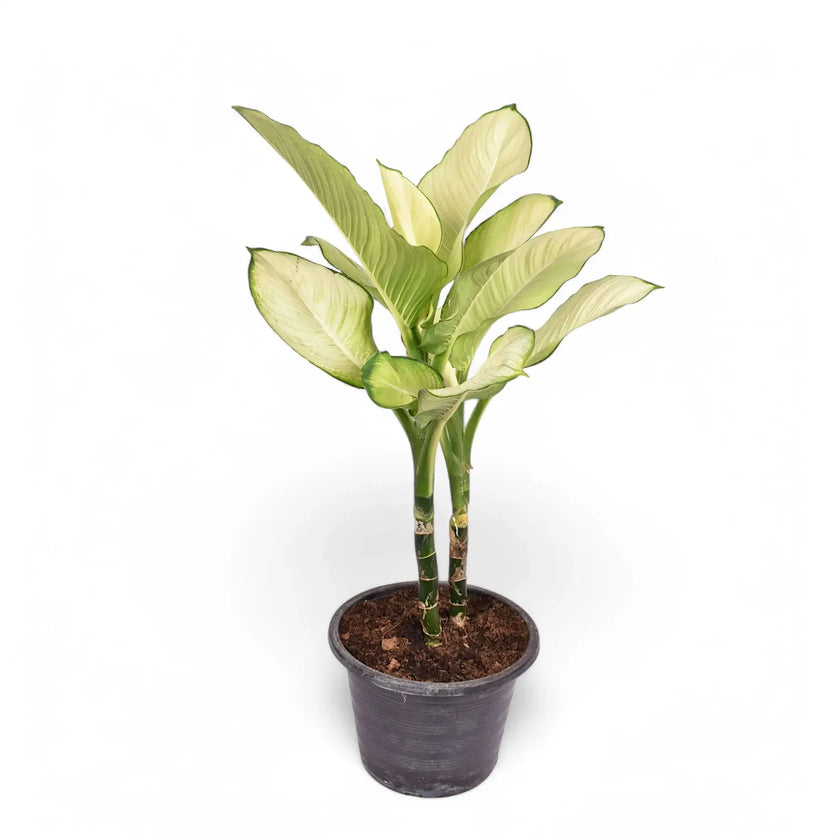
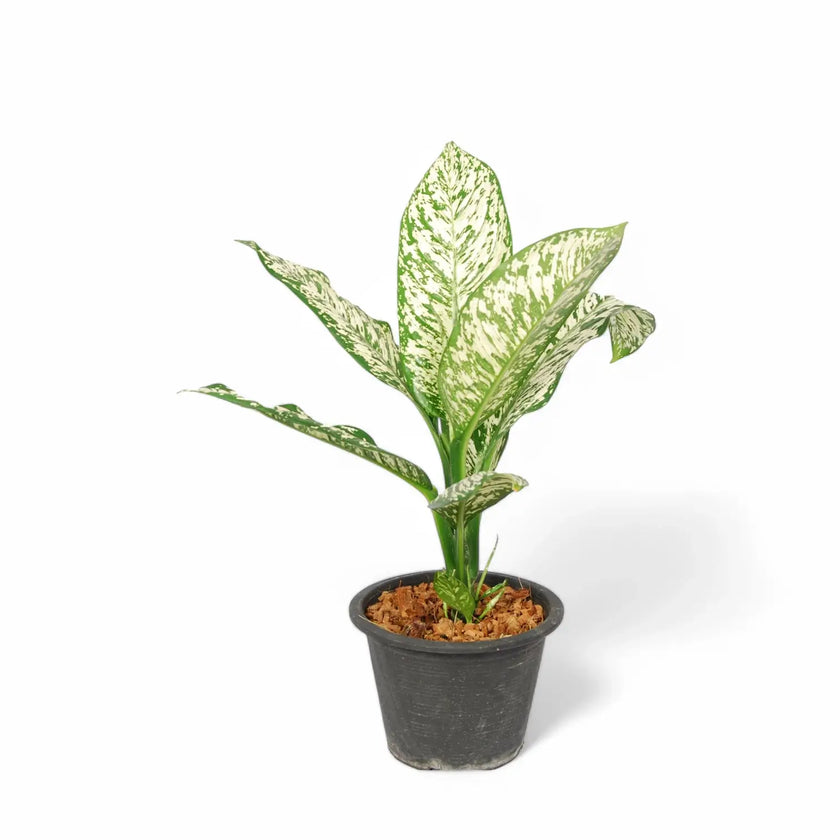
In the wild, many Dieffenbachia species grow as understory canes in warm, humid forests of Central and South America and the Caribbean. Indoors they follow the same basic script: upright stems (canes) with a spiral of leaves at the top, older foliage slowly shed from below, and new leaves appearing from the central growth point.
Given enough light and an airy mix, canes thicken, internodes stay relatively short and plants hold a neat column of leaves. In weaker light, stems elongate and lean, and you get more of a “one-sided palm on a stick” look. Growth is not strictly seasonal; in heated homes Dieffenbachia often grows in pulses throughout the year rather than shutting down completely in winter.
Three habits that keep Dieffenbachia canes solid
- Light with direction and strength: place Dieffenbachia close to a bright window where foliage sees plenty of sky but is not pressed against hot midday glass. East windows, or a step back from strong south and west exposures, usually work well. Good light keeps canes thick and leaves broad with clear variegation. For concrete window examples and simple shadow tests, our bright-indirect light guide is the reference point.
- A root zone that breathes: treat moisture as a cycle, not a fixed schedule. Let the upper layer of substrate lose its cool, damp feel before watering again, then give a full drink that runs through the pot and drains away freely. A mix built from a quality houseplant substrate plus bark, perlite and pumice keeps pores open so roots get oxygen as well as water.
- Warm, steady air: Dieffenbachia is comfortable in the same range you are: roughly 18-27 °C with no sharp night drops next to cold glass. Repeated chills around 12-15 °C combined with wet mix are exactly when canes sulk, leaves yellow and growth stalls. Room humidity around 40-60 % is fine; if air gets very dry for long spells, you will usually see more brown tips unless you raise humidity slightly.
Root zone and feeding: where most Dieffenbachia problems start
Most issues trace back to the pot. Compact, peat-heavy soil in a large container stays cold and wet long after the surface looks dry. Roots sit starved of oxygen, canes soften at the base and yellowing creeps up from older leaves. Switching to a structured mix-houseplant substrate loosened with a visible fraction of bark pieces, perlite and pumice-is often the single biggest upgrade you can make; the principles in our substrates guide apply directly here.
Watering rhythm follows from that structure. Push a finger into the mix or lift the pot: if it still feels cool and heavy, wait; if it is just losing weight and the surface is no longer cold to the touch, it is time for a thorough soak with full drainage. Slow, infrequent deep waterings are safer than constant “sips” that never clear stale water or salts-our watering deep-dive walks through that logic in more detail.
Feeding is straightforward. When Dieffenbachia is clearly pushing new leaves, small, repeated doses of a balanced liquid fertiliser on already moist substrate keep growth steady. Pouring strong fertiliser into dry or waterlogged mix mainly burns tips and stresses roots.
When Dieffenbachia complains: what leaves are saying
- Canes leaning and big gaps between leaves: light is coming from one side and is too weak overall. Shift Dieffenbachia closer to a stronger window, correct the angle and rotate the pot regularly so new growth is more balanced.
- Lower leaves yellowing one by one in heavy, cool mix: roots are sitting wet and short on air. Check that drainage holes are clear, break up any compact mass and move to a more open mix if needed.
- Brown tips and crispy edges on several leaves: usually a combination of inconsistent watering, dry air and salts near the root zone. Flush the pot thoroughly once with soft, room-temperature water, stabilise your watering intervals and, if air is very dry, raise humidity a notch.
- Whole top of the plant suddenly limp: feel the mix. If it is dust-dry and the pot is very light, you are dealing with a hard drought-soak fully, drain well and then watch how fast the pot dries next time. If the mix is saturated and smells sour, roots and cane bases are likely rotting and you need to unpot, cut back to firm tissue and replant in a fresh, airy substrate.
Dieffenbachia sap, toxicity and safe handling
All Dieffenbachia contain dense bundles of insoluble calcium oxalate crystals in sap and tissues. Chewing leaves or canes can trigger immediate burning, swelling and numbness in mouth and throat for people and pets, and sap is unpleasant in eyes or on broken skin.
Practical rules are simple: do not grow Dieffenbachia where toddlers or habitual plant-chewing pets have free access, use gloves for heavy pruning and wash hands and tools after working on the plant. Treated with that level of respect, Dieffenbachia is safe to live with and repays the effort with big, graphic foliage for many years.
What your Dieffenbachia does in the first weeks at home
After shipping or a big move, Dieffenbachia often pauses and recalibrates. One or two older leaves yellowing, a couple of drooping lower leaves or a slight lean towards the window during the first fortnight are normal reactions to a new climate and light pattern, not a sign that the plant is failing.
Unpack, remove only foliage that is fully snapped or rotting, water the existing rootball once if the mix has clearly dried during transit and then let the plant settle in its long-term position. Avoid immediate repotting into a much larger, very wet pot; disturbing roots while they are still adjusting slows recovery. New, firm leaves emerging from the top of the cane are the best indicator that Dieffenbachia has accepted its new conditions.
Back to top and compare the Dieffenbachia that match your light level, your floor space and the pattern you want nearby ↑